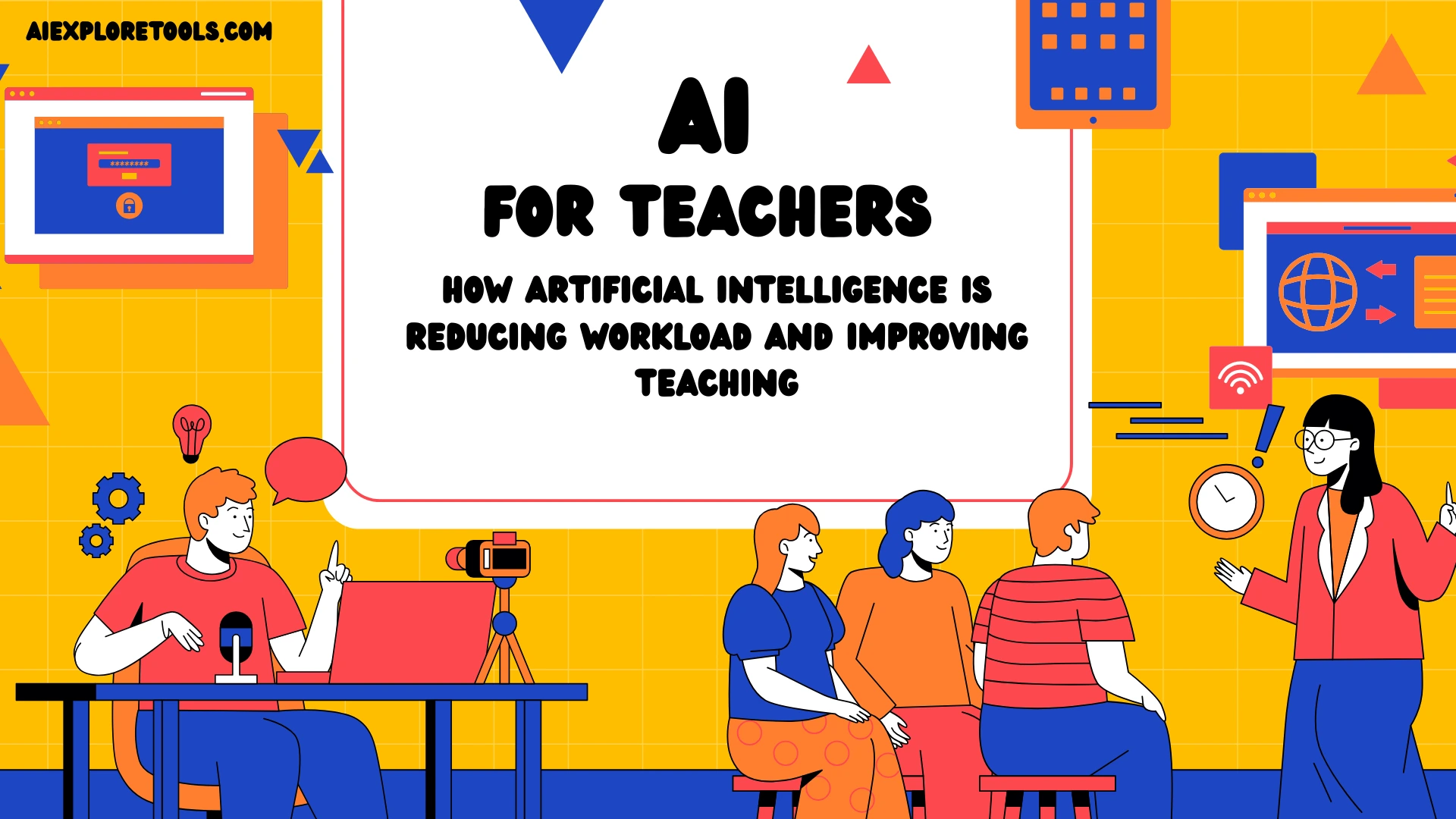
Artificial Intelligence is no longer something that only exists in science fiction or as a tool for tech giants—the use of AI for teachers is now happening every single day on school campuses throughout the globe. The use of AI is impacting educators in the US, UK, India, Canada and numerous other countries; AI for teachers provides educators with ways to create lesson plans, manage student behavior, provide assessments, and help all of their students succeed regardless of different needs.
Teaching has always required an incredible amount of time and energy from a teacher. In addition to planning lessons and grading student work there are also all of the forms and paperwork, communicating with the parents of students day-to-day, and keeping current with the many professional development opportunities that an educator needs. The role of AI in this scenario is very important because it allows teachers to automate many of the repetitive, cumbersome tasks associated with their profession and provide them with important, data-based information so that they can focus on the most important part of their job—helping inspire and motivate their students and improving their results academically.
Implementing an identified number of features within AI for teachers will help to decrease the number of hours a teacher needs to put into their work and improve the quality of their instruction while continuing to support a student-centred model for education.
Understanding AI in Education
Before we highlight the specific advantages of AI, it is vital that we first understand what AI entails and how it relates to education. In layman’s terms, Artificial Intelligence (AI) is the use of computer systems to carry out tasks traditionally involving human intelligence, including data analysis, pattern recognition, content production and prediction-making.
In an educational setting, some examples of AI for educators include:
- Automated Grading Systems
- Lesson Planning Assistants
- Personalised Learning Platforms
- Virtual Teaching Assistants
- Student Analytics and Progress Tracking Systems
AI in teaching does not take the place of educators; instead, it serves as a tool to aid them in their work. AI can assist teachers by providing them with a virtual assistant that performs many of the repetitive tasks associated with teaching. Therefore, teachers are free to focus their time and energy on designing engaging and meaningful lessons for their students to interact with.
Lowering Educators’ Administrative Burden
One of the largest obstacles that teachers face across all four countries is the large amount of time it takes to do the administrative things as teachers. In many cases, teachers will be spending a lot of hours on administrative tasks each week that do not have to do with teaching their students anything.
Automated Grading and Assessment
Grading homework, assessments, and exams takes a significant amount of time for teachers to complete, especially when a teacher has a large number of students in their classroom. However, AI for teachers has made grading homework for the multiple-choice questionnaire style assessments, short-answer answers, or even essay questions extremely easy through its use of natural language processing technology.
In addition to helping save teachers time when using AI-powered grading & assessment tools, they will also provide teachers with a level of standard and unbiased grading. They can provide teachers the option to review the feedback provided by an AI grader and modify it if they wish, allowing them to meet with those students needing additional help with more of their time scheduled.
Attendance and Student Records Management
AI-powered attendance systems can track students’ attendance digitally and as well, automatically generate student attendance reports. For the teachers and administrators in schools that contain a large number of students (i.e., public schools in both India and the United States), the use of AI-powered education tools will eliminate the majority of routine paperwork tasks and allow educators to access accurate and organized data quickly.
Develop Safer Lesson Plans
Managing the day-to-day activities of students is one part of a teacher’s job function; however, it can become monotonous and too time-consuming. By utilising Artificial Intelligence, educators have access to a wide variety of tools that streamline the process of creating high-quality lesson plans in minutes vs hours.
Create Content Using AI
AI allows you to create lesson outlines, quizzes, worksheets, and PowerPoint presentations using your district and/or state standards as the basis for the content that you create. You can change and modify this content to meet your needs based on the needs of your classroom, the age group you are teaching, and the ability level of your students.
Access Resources with Support from AI Technologies
Through AI technologies, educators can find teaching materials such as videos, articles, activities, and assessments that support their goals. Rather than searching multiple websites for various resources, educators receive a complete set of curated resources that align with their curriculum objectives. The use of AI to support educators improves the quality of lessons taught while decreasing the amount of time spent preparing for those lessons.
Personalised Learning in the Classroom
Every classroom has a variety of student learning styles and levels of ability. The teacher has to find ways to accommodate all of these students, who learn at their own pace, so that they all have an equal opportunity to be successful. This is often one of the most challenging aspects of the role of a teacher.
Adaptive Learning Platforms
Teachers can use artificial intelligence to provide personalised learning for their students through adaptive learning platforms that automatically adapt content according to student performance. For example, if a student struggles to grasp a concept, the adaptive learning platform will provide additional opportunities for practice (drill and practice). If a student excels in a particular area, the adaptive learning platform will present an advanced problem/challenge.
This type of adaptive learning approach is particularly effective in parts of the world such as India, where classrooms typically have high teacher-to-student ratios.
Ensuring Inclusive Education
AI tools can assist students who have learning disabilities by providing users with features including speech-to-text, text-to-speech, and translation of written and spoken languages into other languages. AI in teaching allows teachers to create inclusive learning environments without requiring specific technical knowledge or capabilities.
Increasing Engagement of Students
Challenges such as student engagement are present for educators everywhere in the world. The advent of artificial intelligence provides innovative solutions for creating a high level of engagement through interactivity and motivation within learning activities.
Intelligent Tutoring Systems
AI-enabled tutor systems allow learners to receive real-time feedback and support when they are not in the classroom. Such systems will be a great help for enhancing a student’s understanding of the material and provide them with an opportunity to practice what they have learned alone.
For teachers, this means they will talk less and spend more time having rich conversations during class. By making it easier for teachers to engage with their students in the classroom using AI tools, they will have a greater opportunity to teach with numerous other benefits, including being able to teach more efficiently.
Gamification and Interactive Learning
AI-enabled games for education provide opportunities for students to remain motivated through the use of adaptive content. Integrating gamification into the process of teaching and engaging with students through the use of AI will produce a more enjoyable and enriching experience for all.
Insights for Improved Teaching through Data-Driven Decisions
Today’s educational environment is flooded with huge volumes of raw data. Trying to sort and interpret all of this information manually would be nearly impossible for an individual educator. By utilizing Artificial Intelligence (AI), teachers can better understand their data.
Analytical Insights into Student Performance
AI for teachers provides performance dashboards for each student to illustrate their strengths and weaknesses as well as their performance trends over time. The dashboards allow educators to identify at-risk students well in advance of any situations developing.
The data-driven approach to providing teachers with performance dashboards is becoming increasingly popular in both the US and the UK, as accountability and metrics are heavily emphasised in each country’s educational systems.
Enhanced Instructional Strategies
The use of classroom data by AI for teaching allows teachers to continuously evaluate the effectiveness of their instructional methods. Based on classroom data, AI suggests instructional enhancements to assist teachers in maintaining a high-quality learning environment.
Teacher Professional Development Support
Teaching is a profession where continuous learning occurs. The use of artificial intelligence (AI) continues to assist teachers with their learning and improvement.
Customised Training Programs
AI assists teachers by suggesting professional development based on a teacher’s style of teaching, subject taught, and issues faced in the classroom. This allows for timely and appropriate training for skills development.
Tools for Reflective Teaching
AI tools can analyze recorded lessons and provide meaningful constructive feedback. Teachers using these tools are able to identify how well they pace their lessons, how well students respond, and the clarity of their instruction.
AI is rapidly changing our world, including teaching.
AI’s impact on education may vary by geographic region, but it has an impact on students and teachers everywhere.
- The U.S. uses AI to improve analytics, personalize learning and increase administrative efficiency.
- The U.K. uses AI to better align curriculum and assess students more accurately.
- In India, AI is a tool to manage large classrooms, reduce education inequality and bridge the digital divide.
- In Canada, AI is helping foster inclusive education and providing an avenue for remote learning.
In every area, AI for teachers is viewed as a partner, rather than an enemy.
Response To Concerns And Ethical Concerns
While there are many advantages to using AI in education, there are several concerns that must be addressed before these benefits can be fully realised.
Protection Of Student Data
It’s essential for schools to safeguard student data by implementing appropriate security measures. Use of AI as an educational aid should be conducted with transparency, secure systems, and adherence to local laws regarding data protection.
Continuing Human Connection
AI can never replicate authenticity, creativity, and emotional intelligence. AI can assist educators by augmenting their performance as educators; but not substitute them.
AI and Future Education for
As technology evolves, educational institutions will become increasingly reliant on AI. Future developments could include sophisticated virtual assistants, real-time analysis of classroom data, and increasingly individualised training of students.
Teachers who leverage AI as an educational resource will have greater flexibility to adjust to the evolving educational landscape while retaining their own balance of professional and personal lives.
My experience with AI as an assistant to the teacher

The use of AI techniques will help automates repetitive tasks (like grading) and lesson planning so that teachers can concentrate more effort on engaging with their students. There is a benefit of using AI tools that, from my direct experience, will produce better results if the Teacher takes the time to go through the AI’s output and improve upon it, rather than just using the output as-is, without further refining it.
Limitations and Challenges
AI tools may produce poor quality or contextually incorrect output. Therefore, it is important that teachers spend time learning how to utilize AI in a proper manner, and avoid using them in a manner that is inefficient or ineffective.
Ethical and Responsible Use
All teacher data and student data must be treated as confidential and be protected from access by anyone except those who are allowed access to the information. Ethical use of AI tools requires compliance with privacy laws and institutional policies.
Conclusion
Artificial Intelligence is revolutionizing the educational sector with the many benefits that arise. Teachers are now able to perform less excessive administration duties, better design lesson plans, adapt each student’s learning approach to meet their needs, and obtain data-driven information. With this benefit of working more effectively rather than harder, Artificial Intelligence will provide educators with the ability to utilize the best methods for teaching their students.
All around the World – United States, Great Britain, India, Canada, and beyond, Artificial Intelligence has empowered teachers to maximize their available time, enhance the quality of their instruction, and focus on forming strong connections with their students.
When employed appropriately, Artificial Intelligence is not only another technical advancement; it represents an important asset to educators regarding the future of effective, inclusive, and engaging education.

Kotaru Venkata Ramana
I write about AI in education and AI exploration, focusing on how artificial intelligence can support learning, teaching, and the future of education in simple and practical ways.